Used · WWT
Reduced
20ft Shipping Containers
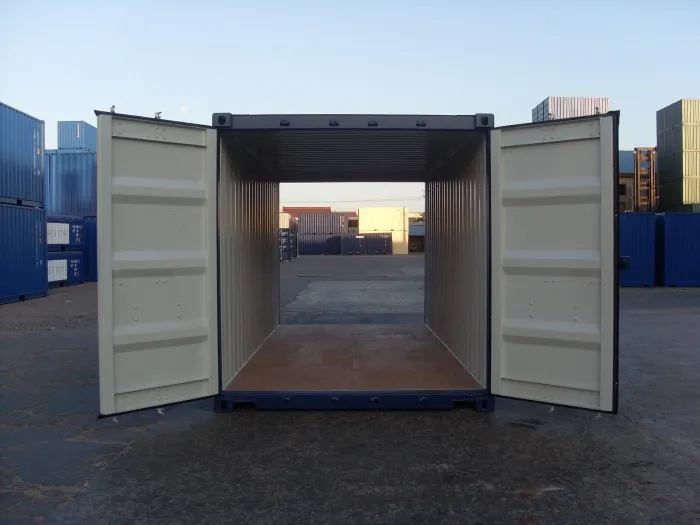
20ft Double Door Shipping Container (Used)
20ft32.90 m³
$2,450 $3,675AUD incl. GST

Guide
External and internal dimensions, volume, tare and payload for 6ft to 40ft high cube containers sold by AAD Logistics, in millimetres.
Drawn to scale from the listed external dimensions.
Shipping containers are built to ISO sizes so they stack, lock and travel on any ship, train or truck. The two sizes you see everywhere are the 20ft and the 40ft. Both are 2,438 mm wide and 2,591 mm high on the outside. A high cube version adds 305 mm of height, taking the outside to 2,896 mm.
AAD Logistics also sells smaller units for sites where a 20ft will not fit. The 6ft, 8ft, 10ft and 12ft sizes cover tool storage, backyard storage and compact site sheds. This guide lists every size we stock with external and internal dimensions, cubic capacity, tare weight and payload.
All measurements below are metric. External sizes for ISO containers are fixed by the standard. Internal sizes, volumes and weights vary slightly between manufacturers, so treat those as typical and confirm on the product page before you order.
External dimensions decide whether a container fits on your block, through a gate or under a carport. Measure the space, then add clearance for the delivery truck. See preparing your site for container delivery for the truck side of the equation.
| Size | Length (mm) | Width (mm) | Height (mm) | Notes |
|---|---|---|---|---|
| 6ft mini | 1,980 (approx.) | 2,100 (approx.) | 2,260 (approx.) | Non-ISO storage size |
| 8ft | 2,500 (approx.) | 2,200 (approx.) | 2,260 (approx.) | Non-ISO storage size |
| 10ft | 2,991 | 2,438 | 2,591 | ISO size |
| 10ft high cube | 2,991 | 2,438 | 2,896 | ISO size, extra height |
| 12ft storage | 3,658 (approx.) | 2,438 | 2,591 | Personnel door and window |
| 20ft | 6,058 | 2,438 | 2,591 | ISO size |
| 20ft high cube | 6,058 | 2,438 | 2,896 | ISO size, extra height |
| 40ft | 12,192 | 2,438 | 2,591 | ISO size |
| 40ft high cube | 12,192 | 2,438 | 2,896 | ISO size, extra height |
The 20ft double door, 20ft open side and their high cube versions share the standard 20ft external footprint. The same applies to the 40ft high cube double door and open side. Only the door arrangement changes, not the box.
Corrugated walls, the floor and the roof take up room. Internal width on a 20ft or 40ft is approximately 2,352 mm, and internal height is approximately 2,393 mm on a standard unit. The door opening is narrower again, so check the product page if you need to fit a wide item through the doors.
| Size | Internal length (mm) | Internal width (mm) | Internal height (mm) | Volume (approx.) |
|---|---|---|---|---|
| 6ft mini | see product page | see product page | see product page | 7.5 m³ |
| 8ft | see product page | see product page | see product page | 10.2 m³ |
| 10ft | see product page | 2,352 (approx.) | 2,393 (approx.) | 15.5 m³ |
| 20ft | 5,898 (approx.) | 2,352 (approx.) | 2,393 (approx.) | 33 m³ |
| 20ft high cube | 5,898 (approx.) | 2,352 (approx.) | approx. 2,393 plus 305 | 37 m³ |
| 40ft | 12,032 (approx.) | 2,352 (approx.) | 2,393 (approx.) | 67 m³ |
| 40ft high cube | 12,032 (approx.) | 2,352 (approx.) | approx. 2,393 plus 305 | 76 m³ |
Internal length on a 20ft is about 5.9 m, which fits a standard car with the doors closed. A 40ft gives about 12 m, enough for two cars end to end or a long run of pallet racking. The container garages keep the 20ft footprint and replace one end with a sectional door.
Tare is the weight of the empty container. It matters for two reasons. The delivery truck has to lift it, and any footing you build has to carry it plus whatever you store inside.
Payload figures come from the CSC plate and apply to sea transport. On a site you will rarely get near them. A 20ft loaded with household goods is usually well under a quarter of its rated payload. Weight is more likely to matter if you store machinery, steel or dense materials on one side of the floor.
Used containers carry the same plate ratings as new ones, but AAD sells used units as Wind and Watertight rather than Cargo Worthy. Read WWT vs Cargo Worthy grades before you rely on a used unit for export.
A high cube is exactly 305 mm taller than a standard container, inside and out. That is the only difference. Length, width, door width and tare are close to identical. The extra height turns a 20ft from approximately 33 m³ into approximately 37 m³ and a 40ft from approximately 67 m³ into approximately 76 m³.
Choose a high cube when you plan to fit racking, park a vehicle with roof bars, or convert the unit into an office or workshop with a lined ceiling. Choose standard height when overhead clearance on the delivery path is tight, or when the container needs to sit under an existing roof. The standard vs high cube guide goes into the trade-offs in detail.
Not every site has 6 m of straight run for a 20ft. The smaller sizes solve that.
All four are delivered on a tilt tray. Browse them in small shipping containers and compare with the larger sizes in 10ft vs 20ft vs 40ft.
Work through these checks before you order.
A typical tilt tray needs a straight run of about 2.5 times the container length plus the truck. A 40ft usually arrives on a side loader or semi trailer instead, which needs clear space along one side. Our delivery guide explains each vehicle.
Match the container to the job, not the other way round.
| Use | Suggested size | Why |
|---|---|---|
| Garden tools, bikes, camping gear | 6ft or 8ft | Small footprint, low cost |
| Trade stock, townhouse storage | 10ft | ISO size, fits tight access |
| Walk-in store room on a site | 12ft storage | Personnel door and window |
| Household move, farm shed, workshop | 20ft or 20ft HC | Most versatile, easy to deliver |
| Forklift or side loading of pallets | 20ft open side | Full side opening |
| Vehicle garage | 20ft or 20ft HC garage | Sectional door, extra headroom on HC |
| Bulk storage, two vehicles, long racking | 40ft or 40ft HC | Twice the volume of a 20ft |
See the full range at shipping containers for sale. Prices are in AUD and include 10% GST. If you are unsure between two sizes, contact us with a photo of the site and we will advise on fit and delivery.
Related products
Ready when you are
Buy online and pay by bank transfer or card, or send us your site details and we will price the unit, the delivery and any modifications together.